

In the name of mental health, the TikTok generation has once again successfully created a phenomenon out of doing the bare minimum — this time, it’s all about performance at work, or more accurately, the decision to provide a lack of it.
“Quiet Quitting”, according to Zaid Khan, a 20-something engineer who introduced this concept to millions, is where you don’t outright quit your job, but you quit the idea of going above and beyond. It is a mindset the counters the harmful side-effects of hustle culture.
Having subscribed to the workaholic principles of hustle culture myself, I’ve experienced the self-destructive nature of this extreme work ethic. It’s a seductive culture that gives you a badge of honor for running on 4 hours of sleep everyday while you work on your business. If you aren’t doing it that way, you aren’t doing enough. At least that’s the practice it morphed into.
Gary Vaynerchuk is arguably the biggest proponent of the hustle culture in its early form. He grew his father’s wine business from $3 million a year to $60 million a year in revenue, while sacrificing his weekends and social life. He also posts about 15 times a day on socials. I adopted this work ethic and built my business from zero to over $2 million a year. It works, though not without cost.
But it isn’t Gary’s fault that hustle culture started getting taken out of context. People needed a social savvy entrepreneur to listen to, and when you only hear bits and pieces of the advice, it’s easy to go overboard.
When asked about work-life balance, Gary says it simply does not exist. But what most people didn’t hear is Gary’s more detailed explanation. He meant that there is no clean model that exists for work-life balance. Pull up his videos and you might hear some version of this: ‘Working long hours is what makes me happy. If that doesn’t make you happy, don’t do it. Find YOUR balance.’
Some people heard it and started a revolution against hustle culture and more towards a slower work pace. Expectedly, people celebrated this movement towards self-care and mental health. You don’t need to do it all to have it all. Besides, Gary has a team of at least a dozen content creators to make him omnipresent. One can only do so much.
The argument for the slow work mindset revolves around mindfulness, respect, and boundaries. If the work environment is conducive, one does a proper job. One might even go over and beyond. And if the workplace is toxic, they might get called out. Usually, however, the calling out is done more passive-aggressively through the form of humorous TikTok’s and memes on Instagram.
Just like hustle culture, the slow work philosophy has now also been taken to the extreme. Quiet quitting has become the trendy thing to do at work, and company executives are paying attention. “People who shut down their laptop at 5… they don’t work for me,” says business mogul Kevin O’Leary in a CNBC video. “I hope they work for my competitors.”
Now, if the leader treats the team well, you get stellar performance. So yes, quiet quitting might be a sign of bad management. But if one observes more closely, it’s also only the beginning of something more problematic: the empowerment of mediocrity.
A yardstick of conditional professionalism
Quiet quitting means coasting is in. The mindset aims to make a point: We’ll only be professional for as long as certain positive conditions are met.
Can you imagine if a soldier said that? I’ll only show up to fight if we weren’t being bombed so much. Who cares about honor?
What if a doctor said it? I’ll only operate on this patient and keep them alive if people would just stop pressuring me.
Excellence is hard. It has to be. Without the difficulty, you’re forever a novice. And I fear that that’s where quiet quitting brings people to.
Now it might be reflective of the leadership at work, but it is also an indication of the lowering of standards to the bare minimum and giving yourself a gold star for it. This prevents any opportunity to reach excellence — something you can only truly achieve in the face of adversity. So while coasting is in, that also means greatness is out. Because you simply cannot be great while you do half-assed work.

A litmus test for standards
If you’ve unwittingly entered a bad work environment, your professional standards should lead you to a much more productive course of action than passive-aggressively quiet quitting. If you allow yourself to compromise the quality of your work just to prove a point, then you might want to rethink what your standards even were.
As a professional, there’s a compelling cause to hold yourself against a high standard. This means that if your workplace prevents you from upholding these standards (because of toxic environments, bullying, low pay, impossible pace), then it is your responsibility to let your superiors know so you can keep doing a good job, or find another workplace that complements and appreciates your standards. In other words, you owe it to yourself to do an excellent job, regardless of your environment. Why? Because you have standards.
It’s not about being professional because your company deserves your best. It’s about being professional because that’s who you are.
The cycle of disappointment
Contrary to the popular belief that quiet quitting is a protective move, it is actually highly destructive — and it’s mutually assured destruction at that.
If you’re a part of a company, then you’re a part of a machine, in which case, the things you do will affect everyone.
With quiet quitting, instead of having the difficult conversations, you avoid conflict, and you do the bare minimum in hopes that the company learns a lesson and treats you better. But while that’s happening, you’re contributing to a vicious cycle of disappointment. Bad leadership leads to pressured middle management, which leads to a quiet quitting team, which leads to inferior output, which leads to unhappy customers, which lead to stunted business growth… and then it’s back to the leadership making questionable decisions because of the bad numbers.
Do a great job. Be assertive when conditions prevent you to do so. Best case scenario, the company listens and makes a change. Worst case, you leave and find some place better.
Going over and beyond isn’t special. It’s expected of highly-motivated people.
I guess this boils down to whether or not the bare minimum work ethic makes you proud of yourself. If it truly does, then coast away. Although it is worth asking, if you were inspired, motivated, and driven, would you be coasting?
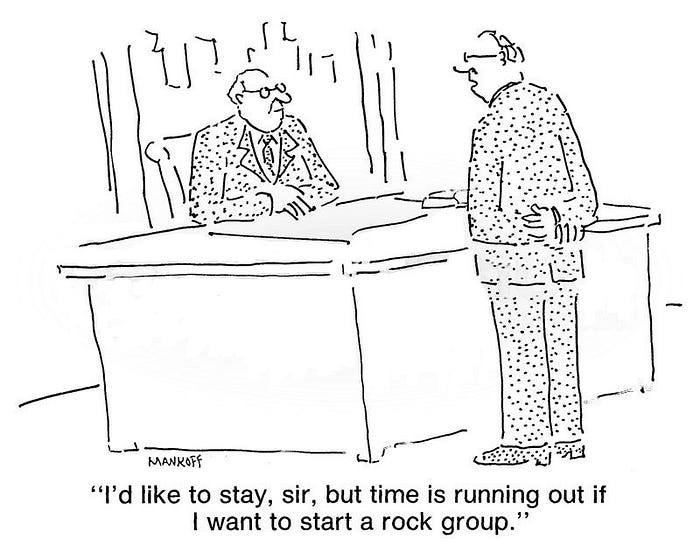
Here’s a better move: JUST QUIT.
Now, now, I’m not trying to be radical.
Quiet quitting is very meta. How funny it is do everything so half-heartedly that even your quitting is half-hearted. A half-baked act of quitting work that is done half-baked.
If you’re not happy where you are, move. But be smart about it. If your finances are tight, stick it out at some job while you get better at something you love. Save up, and then make a gameplan to find something better or get paid to do what you like.
Staying and quiet quitting in a place that doesn’t respect you is subjecting yourself to a lowkey form of oppression where your creativity, ideas, and opinions aren’t being recognized.
Quitting your job when it isn’t respecting your professional standards doesn’t mean you’ve abandoned your goals. It’s simply self-respect. After all, isn’t that the whole point?
“The lack of your best hurts everything.” Dr. Jordan Peterson